 By
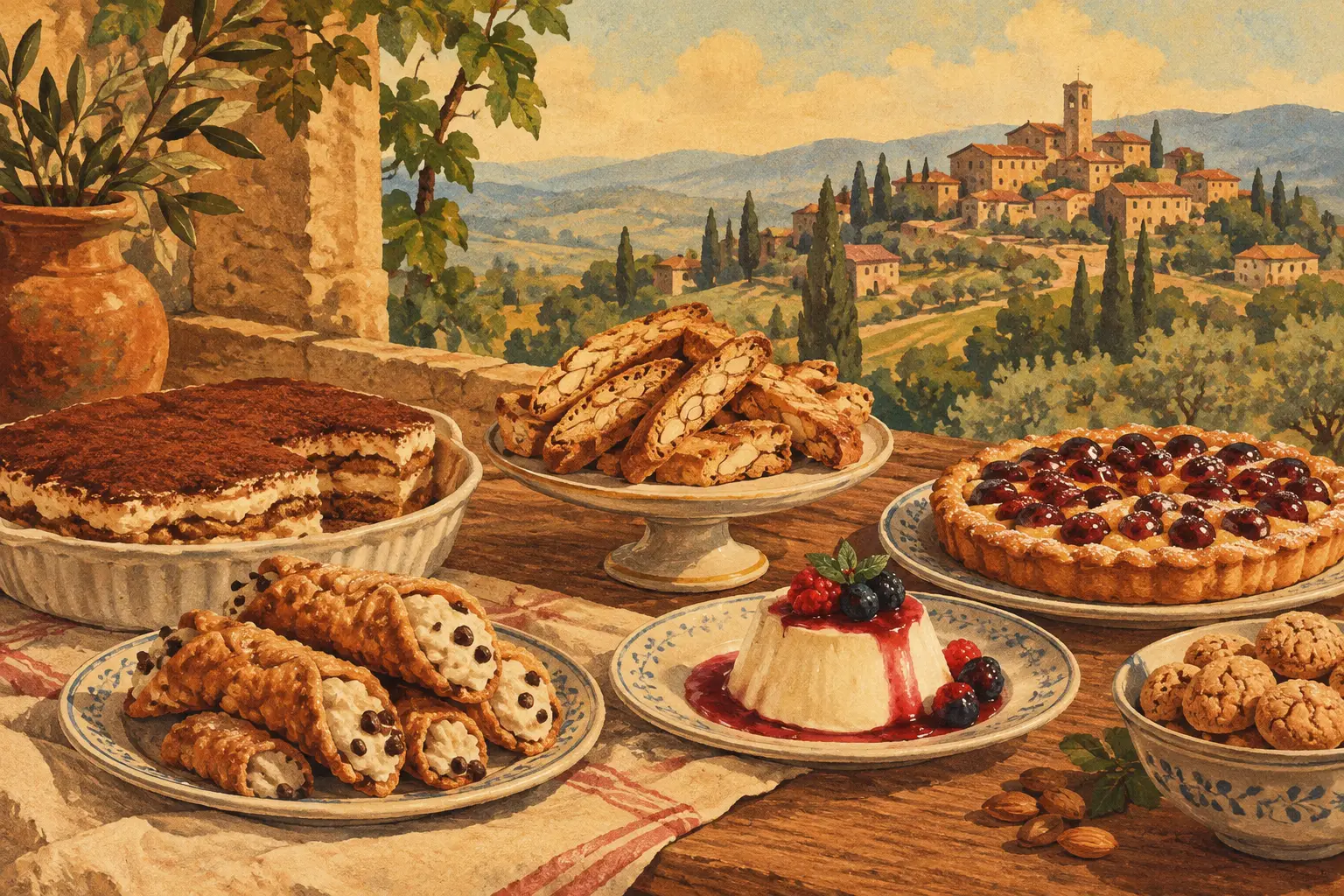
A Tuscan meal has its own rhythm. It begins with appetite, lingers over conversation and wine, and ends not with extravagance for its own sake, but with something sweet that feels right for the table. Homemade Italian desserts Tuscany holds dear are made in that spirit: recognisable ingredients, patient hands and recipes shaped by season, family and place.
Around Volterra, dessert is often less about spectacle than the pleasure of a warm tart brought to the table, biscuits broken between friends, or a spoonful of cream softened by a local dessert wine. The finest versions carry a sense of restraint. They let almonds taste of almonds, eggs give a cake its golden richness, and fruit speak clearly when it is at its best.
What makes homemade Italian desserts in Tuscany distinctive
Tuscan sweets are often beautifully economical. Flour, eggs, milk, sugar, almonds, citrus and seasonal fruit appear again and again, yet the results are varied. This is cooking built on good produce rather than elaborate decoration.
There is also a strong relationship between desserts and hospitality. A plate of cantucci with vin santo encourages guests to stay a little longer. A rustic crostata can belong equally to breakfast, an afternoon coffee or the end of a leisurely lunch. In a region where the landscape asks you to slow down, these are desserts with room for the moment around them.
That simplicity does not mean they are effortless. A torta della nonna needs a shortcrust pastry that is crisp but tender. Castagnaccio depends on the quality of chestnut flour and a careful hand with rosemary. Cantucci need enough time in the oven to become properly dry without losing their almond fragrance. The details are quiet, but they matter.
Eight desserts that tell Tuscany’s story
Cantucci with vin santo
Cantucci are Tuscany’s famous almond biscuits, baked twice to create their characteristic snap. They are often called biscotti beyond Italy, but in Tuscany they are simply cantucci: oval slices of a firm, almond-studded dough, golden at the edges and made for dipping.
They are traditionally served with vin santo, the region’s amber-hued sweet wine. The biscuit softens briefly in the glass, taking on the wine’s notes of dried fruit and honey. It is a small ritual, especially welcome at the end of a long meal outdoors as the evening cools.
Torta della nonna
Despite its name, which means grandmother’s cake, torta della nonna is far too good to be reserved for nostalgia. It combines a buttery pastry case with a lemon-scented custard filling, finished with pine nuts and a light dusting of icing sugar.
The contrast is its charm: soft custard, crisp pastry and the gentle resinous bite of toasted pine nuts. Some families cover the filling with a second layer of pastry, while others leave it open. Both approaches are true to the dessert’s generous, home-kitchen character.
Crostata with seasonal fruit or jam
A crostata is one of the most useful and beloved Tuscan bakes because it changes with the pantry and the season. In spring it may hold apricots or strawberries; in late summer, figs, peaches or plums; in cooler months, a deep layer of good jam beneath its lattice pastry top.
At its best, the pastry is not overly sweet and the filling is allowed to remain slightly tart. That balance makes a crostata as welcome with morning coffee as it is after dinner. It is also a reminder that a homemade dessert need not be complicated to feel special.
Castagnaccio
Castagnaccio is one of Tuscany’s most distinctive cakes, though it is not a cake in the rich, buttery sense. It is made with chestnut flour, water, olive oil, pine nuts, raisins and rosemary. Dense, dark and gently sweet, it has an earthy flavour that belongs to autumn woods and cooler evenings.
Its character can surprise anyone expecting a conventional pudding. Chestnut flour has a naturally sweet, almost smoky depth, and rosemary adds a savoury lift. This is a dessert for those who enjoy flavour over frosting, especially alongside a small glass of vin santo or a simple coffee.
Schiacciata alla fiorentina
Schiacciata alla fiorentina is a light, square sponge traditionally associated with Carnival in Florence. Its sunny yellow crumb comes from eggs and often a little orange zest, while its top is dusted generously with icing sugar. Many versions carry the Florentine lily in cocoa at the centre.
It looks celebratory, yet its appeal is wonderfully uncomplicated. The sponge should be soft rather than heavy, with a clean citrus perfume. A filling of lightly sweetened cream can be lovely, but it is not essential. The cake stands perfectly well on its own with tea or coffee.
Zuccotto
Zuccotto has a more theatrical shape, a domed mould said to echo the architecture of Florence. Traditionally, a lining of sponge or biscuits encloses a chilled filling of ricotta or cream, chocolate, nuts and sometimes candied fruit. It is served in slices, revealing its contrasting layers.
Because it is made ahead and chilled, zuccotto suits warm weather and relaxed gatherings. Its richness means a modest slice is enough. For a more restrained table, a ricotta-led filling with dark chocolate and toasted hazelnuts keeps the dessert balanced rather than overly sweet.
Frittelle di riso
Rice fritters are especially connected with spring celebrations, including the feast of Saint Joseph. Cooked rice is enriched with milk, sugar and citrus, then shaped or spooned into hot oil until golden. A final coating of sugar gives them their festive finish.
They are best eaten warm, when the outside is crisp and the centre still soft. Their humble ingredients say much about Tuscan home baking: nothing wasted, nothing needlessly complicated, and plenty of comfort in a small portion.
Panforte
Panforte comes from Siena, but its presence is felt across Tuscany, particularly in the festive season. Dense with nuts, candied peel, dried fruit and warming spices, it is pressed into a low round and finished with icing sugar. A thin slice delivers far more flavour than its size suggests.
There are sweeter and spicier versions, and preferences are often personal. Panforte is not a dessert for a towering portion. It is best shared slowly, perhaps after dinner with coffee, when its pepper, cinnamon and citrus notes have time to unfold.
The ingredients deserve the spotlight
For anyone baking these desserts at home, ingredient quality changes the result more than decorative skill. Fresh free-range eggs give sponge and custard their colour. Proper butter makes pastry fragrant. Unblanched almonds bring more flavour to cantucci, while a good extra-virgin olive oil can give castagnaccio its distinctive finish.
Seasonality matters, too. A fig crostata in September needs very little help beyond ripe fruit and pastry. In winter, citrus zest, raisins, nuts and chestnut flour bring brightness and warmth. Trying to recreate every dessert at every time of year can miss the point. Tuscan cooking has always made the most of what the season offers.
Wine pairing should be equally intuitive. Vin santo is the natural companion for cantucci and works beautifully with torta della nonna or panforte. A coffee may be better with schiacciata or a fruit crostata, while castagnaccio can suit either depending on how sweet the recipe is. The aim is not a rulebook, but a finish that feels generous.
A sweet ending, shared properly
At Osteria Etrusca, the pleasure of dessert belongs to the wider table: the final course after an unhurried meal, the view opening beyond the patio, and the company that makes one more bite worthwhile. Whether it is a crisp cantuccio, a slice of custard tart or a seasonal crostata, the best homemade Italian desserts from Tuscany ask for only one thing: allow yourself enough time to enjoy them.