 By
By The first clue is the scent. Before the coffee arrives, before the morning light has fully settled over the hills, fresh pastries in Tuscany announce themselves in butter, citrus peel, warm sugar and baked dough. It is one of the loveliest reasons to slow down on holiday – not to eat in haste, but to begin the day with something just made, still delicate from the oven, and best enjoyed without looking at the time.
In Tuscany, breakfast is often simpler than visitors expect, but that is part of its charm. The pleasure comes from quality, rhythm and setting. A well-made pastry, a proper cappuccino and a quiet table can feel more memorable than a lavish buffet. When the ingredients are good and the baking is fresh, very little else is needed.
What makes fresh pastries in Tuscany so distinctive
Tuscany does not rely on excess. Its food culture tends towards balance, seasonality and confidence in local ingredients, and pastries follow the same instinct. You will find sweetness, of course, but rarely anything cloying. Cream is used with care. Jam tastes of fruit rather than sugar. Citrus, almonds, hazelnuts and good flour appear often, and the textures matter just as much as the fillings.
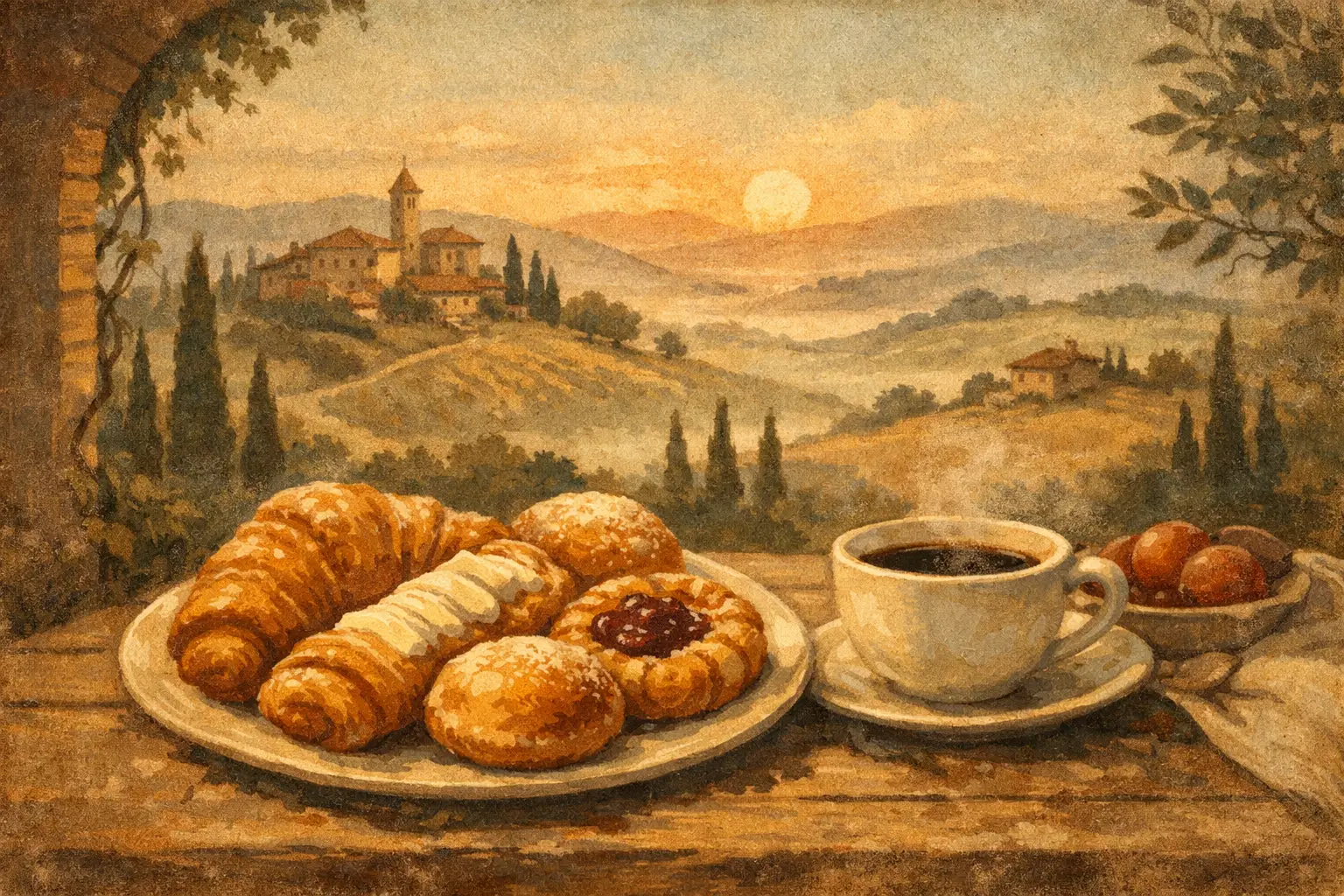
The classic morning choice is the cornetto. Visitors sometimes compare it to a croissant, but the resemblance only goes so far. A cornetto is usually softer, slightly sweeter and less aggressively flaky. It may be plain, or filled with apricot jam, pastry cream, chocolate or pistachio. When served fresh, it has that lovely contrast between a tender outer shell and a warm, fragrant centre.
Beyond cornetti, regional habits begin to show. In some places you may come across crostate with jam, simple breakfast cakes scented with lemon, or biscuits that seem modest until you taste the quality of the butter and eggs. This is where Tuscany is at its most persuasive. It does not shout. It invites.
The morning ritual matters as much as the pastry
To understand why pastries feel different here, it helps to notice how they are eaten. In much of Italy, breakfast is brief, but that does not mean careless. People stand at the bar for espresso and a pastry, exchange a few words, then carry on with the day. In more leisurely settings, especially when travelling, breakfast stretches into something softer and more restorative.
That slower pace changes the experience. A warm pastry in a beautiful place tastes better because you are giving it your full attention. The coffee is not a caffeine delivery system. The pastry is not fuel. Together, they become a small daily ceremony, and Tuscany, with its light, landscape and sense of calm, lends itself naturally to that kind of morning.
For travellers from Britain, this can be one of the quiet joys of a stay in the region. Back home, breakfast is often practical. On holiday, it can return to being pleasurable. Fresh baking, proper coffee and a view worth lingering over create the sort of memory that stays longer than any itinerary.
Not every pastry experience is the same
It depends where you go, and that is worth saying plainly. In busy tourist centres, some pastries are made for volume rather than freshness. They may look handsome enough behind glass, but the texture gives them away – too dry, too sweet, or simply forgettable. A beautiful piazza does not always guarantee a good breakfast.
The more rewarding places tend to share a few qualities. They bake regularly, keep the offering focused rather than endless, and treat breakfast with the same respect they give lunch and supper. You can often tell within a moment of arriving. The pastry case looks cared for rather than overfilled. The coffee smells rich. The service is unhurried but alert.
There is also a trade-off between tradition and variety. Some guests hope for a long menu of pastries, but a shorter range often means better baking. A place that offers a handful of cornetti, a tart, a cake and perhaps one or two house specialities may be making them properly. Restraint can be a very good sign.
What to look for at breakfast
Freshness reveals itself in simple ways. The pastry should feel light in the hand, not heavy from sitting too long. Fillings should taste clean and distinct. Jam should still have brightness. Cream should be silky rather than stiff. If the pastry is served warm, it should feel naturally warm from recent baking, not reheated into submission.
Coffee matters too. A good cappuccino alongside a fresh pastry is one of Tuscany’s great uncomplicated pleasures. The milk should be smooth, the espresso balanced, and neither should overpower the pastry beside it. When both are done well, breakfast feels less like a meal and more like a mood.
The best pastries reflect the place around them
One of the reasons breakfast feels so satisfying in Tuscany is that it belongs to the wider landscape. You taste local habits in the baking, but you also feel the region in the way breakfast is staged – sunlight on terracotta, air that still carries the coolness of early morning, trees moving lightly beyond the terrace. Even a simple pastry becomes part of a much fuller sensory experience.
That is why location is not a trivial detail. A pastry eaten on a noisy street corner can still be excellent, but in a quieter setting it has room to become something more. For couples, it turns into a shared ritual. For families, it becomes the gentle start to a day out rather than a logistical stop. For anyone seeking rest, it offers that rare thing on holiday – a moment with no pressure attached.
At places such as Osteria Etrusca, where breakfast sits naturally within a slower, more beautiful rhythm of the day, the appeal goes beyond what is on the plate. Fresh pastries, coffee, open air and the Tuscan landscape work together. You are not simply eating well. You are settling into the region properly.
Sweetness, seasonality and local character
The most memorable pastries often carry a seasonal note. In cooler months, that may mean richer fillings, nuts and deeper flavours. In warmer weather, citrus, lighter creams and fruit preserves feel more fitting. Tuscany is not rigid about this, but the best kitchens tend to follow the season rather than ignore it.
This also explains why some of the finest breakfast pastries are the simplest. A plain cornetto made with care can be more satisfying than something overcomplicated. The same goes for a slice of cake with lemon zest, or a crostata filled with good apricot jam. There is elegance in that restraint. It leaves room for the quality of the ingredients to show through.
For guests who are more accustomed to hotel breakfasts with heavy international options, this can take a little adjusting to at first. Yet many come to prefer it. A lighter, better-made breakfast feels more in tune with the climate, the pace of the day and the kind of holiday Tuscany does best.
How to enjoy fresh pastries in Tuscany like a local, without pretending to be one
There is no need to perform expertise. The best approach is simply to order what looks good, eat it while it is fresh and give yourself enough time to enjoy it. If you like your breakfast sweet, Tuscany makes that easy. If you prefer balance, choose a plain pastry and let the coffee do more of the work.
If you are travelling as a family, it often makes sense to order a few different pastries for the table. Children usually gravitate towards chocolate or custard fillings, while adults may prefer jam, pistachio or something plain and buttery. Sharing works well because the pastries are rarely oversized, and part of the pleasure is tasting more than one thing.
For couples, breakfast can become one of the most romantic parts of the day, especially when it is unhurried. There is something deeply civilised about beginning with pastries, coffee and a quiet view instead of rushing straight into plans. Tuscany rewards that choice.
Fresh pastries in Tuscany are not grand cuisine, and that is exactly why they matter. They remind you that pleasure can be light, local and wonderfully unforced. If you find the right place, the morning begins to feel less like a prelude and more like part of the holiday itself.